The Complete Mattress Firmness Guide: Find Your Perfect Match

Choosing the wrong mattress firmness is one of the biggest mistakes you can make for your sleep health. Too soft, and you'll wake up with back pain. Too firm, and your pressure points will ache all night. But here's the problem: firmness is subjective, and what feels 'medium-firm' to one person might feel completely different to another. This guide will help you decode mattress firmness ratings, understand how your body weight and sleep position affect your needs, and find the perfect firmness level for restorative sleep.
What is Mattress Firmness? (And Why It Matters)
Mattress firmness refers to how soft or hard a mattress feels when you first lie down on it. It's the immediate sensation you experience—whether you're sinking into the mattress or floating on top of it. This initial feel dramatically affects your comfort, pressure relief, and ultimately, your sleep quality.
Here's what many people don't realize: firmness is not the same as support. A mattress can be soft yet still provide excellent spinal support. Conversely, a firm mattress might fail to keep your spine aligned. We'll explore this crucial distinction later in the guide.
The Industry Standard
Most mattress companies rate firmness on a scale of 1-10, where 1 is cloud-soft and 10 is rock-hard. A rating of 6.5 is considered the industry standard for 'medium-firm'—the most popular firmness level that works for about 80% of sleepers.
Your ideal firmness depends on three primary factors: your sleep position (side, back, or stomach), your body weight, and your personal comfort preferences. Get the firmness wrong, and you might experience morning stiffness, numbness in your extremities, or that feeling of never quite getting comfortable.
Understanding the Firmness Scale: 1-10 Breakdown
The mattress industry uses a 1-10 firmness scale to help consumers compare different beds. Here's what each level actually feels like:
1-2: Extremely Soft
Almost non-existent in the market. Would offer too much sinkage to be functional. Your body would sink so deeply that proper spinal alignment would be impossible.
최적: Not recommended for anyone
3-4: Very Soft to Soft
Deep body contouring with significant sinkage. Usually features thick memory foam or plush pillow tops. You'll feel 'hugged' by the mattress with minimal pushback.
최적: Strict side sleepers under 130 lbs, those needing maximum pressure relief
5: Medium-Soft
Noticeable sinkage but with some support. Soft comfort layers balanced by a supportive core. You'll feel cradled but not stuck.
최적: Side sleepers, lightweight combination sleepers
6-6.5: Medium to Medium-Firm
The 'Goldilocks zone' for most sleepers. Balanced pressure relief and support. Moderate sinkage with decent responsiveness. This is where most bed-in-a-box mattresses land.
최적: Back sleepers, combination sleepers, couples with different preferences, most average-weight sleepers (130-230 lbs)
7-8: Firm to Very Firm
Minimal sinkage with strong pushback. You'll sleep 'on' the mattress rather than 'in' it. Limited body contouring but excellent support.
최적: Stomach sleepers, back sleepers over 230 lbs, those with lower back pain requiring extra support
9-10: Extra-Firm to Ultra-Firm
Almost no give whatsoever. Feels similar to sleeping on a very thin mattress on the floor. Virtually no pressure relief.
최적: Heavyweight stomach sleepers (over 250 lbs), those with specific medical recommendations
Firmness by Sleep Position: The Golden Rules
Your sleep position is the single most important factor in determining your ideal firmness. Here's why:
Side Sleepers: Need Soft to Medium (3-6)
Side sleeping creates intense pressure points at your shoulders and hips—the two widest parts of your body. If your mattress is too firm, these pressure points won't sink in enough, causing pain and restricted blood flow (that 'pins and needles' feeling).
Side sleepers need a softer surface that allows their shoulders and hips to sink while keeping the waist supported. This creates a straight spinal alignment from a side view.
Target firmness: 4-6 out of 10. Side sleepers under 130 lbs might prefer a 3-4, while those over 180 lbs might need a 5-6.
Back Sleepers: Need Medium to Medium-Firm (5-7)
Back sleepers are the easiest to please because this position naturally distributes weight more evenly. However, you still need the right firmness to keep your lumbar region (lower back) properly supported.
Too soft, and your hips will sink too deeply, creating a hammock effect that strains your lower back. Too firm, and you'll have a gap under your lumbar curve, also causing discomfort.
Target firmness: 5.5-7 out of 10. Most back sleepers thrive on a true medium-firm (6.5). Those with lower back issues might prefer slightly firmer (7).
Stomach Sleepers: Need Firm to Extra-Firm (7-9)
Stomach sleeping is the most challenging position for spinal alignment. Your hips are the heaviest part of your body, and if they sink too deeply, your spine curves unnaturally (like a banana), causing serious lower back pain.
Stomach sleepers need a firm surface that keeps their hips elevated and level with their shoulders. This is non-negotiable for avoiding back problems.
Target firmness: 7-8 out of 10. Lightweight stomach sleepers (under 150 lbs) might get away with a 6.5, but most need at least a 7. Heavyweight stomach sleepers (over 230 lbs) should target 8-9.
Combination Sleepers: Need Medium-Firm (6-7)
If you change positions throughout the night, you need a mattress that accommodates multiple postures. This usually means compromising toward the middle of the firmness scale.
Medium-firm mattresses offer enough softness for side sleeping and enough support for back sleeping. If you occasionally sleep on your stomach, aim for the firmer end (7) of the medium-firm range.
Target firmness: 6-7 out of 10. True combination sleepers (who spend equal time in each position) should aim for 6.5.
How Body Weight Changes Everything
Here's a fact that surprises many shoppers: your body weight dramatically affects how you experience firmness. A 120 lb person and a 250 lb person will perceive the same mattress completely differently.
Why? Because heavier bodies compress mattress materials more deeply, experiencing layers that lighter bodies never reach. A mattress rated '7 out of 10' might feel like a 7 to a 180 lb person, but feel like a 5.5 to a 250 lb person.
Lightweight Sleepers (Under 130 lbs)
You don't compress mattress materials as deeply, so you interact mostly with the comfort layers (top 2-3 inches). This means:
- You'll perceive mattresses as firmer than average-weight people
- You need softer mattresses to get adequate pressure relief
- Memory foam and plush tops work great for you
Subtract 1-1.5 points from standard recommendations. If you're a back sleeper, try a 5-5.5 instead of 6.5.
Average Weight Sleepers (130-230 lbs)
You're in luck—most mattresses are designed with you in mind. Standard firmness recommendations apply directly to you:
- Side sleepers: 4-6
- Back sleepers: 5.5-7
- Stomach sleepers: 7-8
Follow standard firmness guidelines for your sleep position.
Heavyweight Sleepers (Over 230 lbs)
You compress mattresses deeply, reaching the support core faster than lighter sleepers. This means:
- You'll perceive mattresses as softer than average-weight people
- You need firmer mattresses to prevent 'bottoming out' (sinking to the hard base)
- Look for mattresses specifically designed for heavy sleepers, with reinforced support cores
Add 1-2 points to standard recommendations. If you're a side sleeper, try a 6-7 instead of 4-5. Prioritize hybrid mattresses with strong coil support.
Firmness vs. Support: The Crucial Difference
This is where most people get confused. Let's clear it up once and for all:
Firmness = Comfort (Subjective Feel)
How soft or hard the mattress feels when you first lie down. This is about immediate sensation and pressure relief. Firmness is subjective—what feels medium to you might feel firm to someone else.
Support = Spinal Alignment (Objective Function)
How well the mattress keeps your spine in a neutral, natural position. Support is about structure and biomechanics. A mattress either supports your spine properly or it doesn't—this is objective.
The Mind-Blowing Truth
A soft mattress can provide excellent support if it has a well-designed core. A firm mattress can provide poor support if it doesn't accommodate your body's curves. Don't assume 'firm = supportive.'
Example: A side sleeper on a too-firm mattress might have perfect spinal alignment in their lower back (good support), but terrible pressure point pain at their shoulders (poor comfort). Conversely, a stomach sleeper on a too-soft mattress might feel comfortable initially (good comfort), but wake up with back pain because their hips sagged (poor support).
Common Firmness Mistakes (And How to Avoid Them)
Mistake #1: Assuming Firm = Better Support
Many people think a firmer mattress is always more supportive. Wrong. Support comes from how the mattress interacts with your specific body type and sleep position. An extra-firm mattress can cause just as many alignment issues as an ultra-soft one.
Mistake #2: Ignoring Your Weight
Online reviews are useful, but remember: a 140 lb reviewer's 'medium-firm' experience might feel totally different to you if you weigh 200 lbs. Always consider the reviewer's weight when reading opinions.
Mistake #3: Choosing Firmness Based on Partners
If you and your partner have different firmness needs (common with different weights or sleep positions), don't split the difference. Consider a split mattress, an adjustable base, or a mattress specifically designed for couples with varying firmness zones.
Mistake #4: Not Factoring in Break-In Time
Many mattresses, especially memory foam ones, soften slightly over the first 30-60 days as materials adjust to your body. If a mattress feels slightly too firm out of the box, give it 2-4 weeks before making a final judgment.
Mistake #5: Assuming 'Medium-Firm' is Universal
While 6.5 out of 10 is the industry standard medium-firm, different brands measure this differently. One company's 'medium-firm' might be another's 'firm.' Always check the specific firmness rating (1-10 number) if provided.
Mistake #6: Testing in the Wrong Position
When testing a mattress in a store or during a trial, make sure to lie in your actual sleep position for at least 10-15 minutes. Don't just sit on the edge or lie on your back if you're a side sleeper.
Mistake #7: Forgetting About Mattress Toppers
If you buy a mattress that's slightly too firm, you can add a soft topper (2-3 inches of memory foam or latex). However, you can't make a too-soft mattress firmer with a topper. When in doubt, err slightly firmer.
Special Considerations: When Standard Rules Don't Apply
Couples with Different Needs
If one partner is 130 lbs and a side sleeper while the other is 220 lbs and a back sleeper, you have a challenge. Solutions: (1) Get a mattress with dual firmness zones, (2) Use separate toppers on each side, (3) Consider two twin XL mattresses pushed together, (4) Compromise on medium-firm (6.5) with individual toppers.
Chronic Back Pain
Counter-intuitively, most back pain sufferers don't need extra-firm mattresses. Research shows medium-firm (5.5-6.5) works best for most people with back pain. The key is proper spinal alignment, not firmness. Exception: If you have degenerative disc disease, you might need firmer support (7-8).
Pregnancy
As pregnancy progresses and weight increases, you might find your mattress feeling softer than usual. Many pregnant side sleepers benefit from adding a 2-inch soft topper for extra hip and belly support, rather than replacing the entire mattress.
Older Adults
Seniors often have more sensitive pressure points and may benefit from slightly softer mattresses than they used when younger. However, avoid going too soft, as getting in and out of a very soft mattress can be difficult. Aim for the softer end of medium-firm (5.5-6) for most positions.
Athletes and Active Individuals
If you have higher muscle mass, you might need firmer mattresses than your weight alone suggests, because muscle is denser than fat. Muscular side sleepers often do better on medium (5-6) rather than soft (3-4).
How to Test Firmness: The 15-Minute Rule
Whether you're testing in a store or during a home trial, here's how to properly evaluate firmness:
Step 1: Lie Down in Your Primary Sleep Position
Not on your back if you're a side sleeper. Not sitting on the edge. Get into the exact position you sleep in most often. Wear comfortable clothes similar to what you sleep in.
Step 2: Stay There for 15 Minutes
Your initial impression doesn't tell the whole story. Materials need time to compress and respond to your body. Set a timer and stay put for at least 15 minutes. (In a store, don't be embarrassed—serious mattress shopping requires serious testing.)
Step 3: Check for Pressure Points
After 10-15 minutes, do you feel any discomfort at your shoulders, hips, or lower back? These are your key pressure points. If you're experiencing pain or numbness, the firmness isn't right.
Step 4: Test the Hand Slide
While lying on your back, try to slide your hand under your lower back. There should be a small gap, but your hand shouldn't slide through easily. If there's a huge gap, the mattress is too firm. If your back is pressed flat with no gap, it might be too soft.
Step 5: Try Changing Positions
Even if you're a strict side sleeper, try switching positions. You do move during the night. Does the mattress respond well, or do you feel stuck? Good firmness should allow for natural movement.
Step 6: Consider the Morning After
During home trials, pay attention to how you feel each morning for the first 2-3 weeks. Morning stiffness that improves throughout the day might indicate firmness issues. (Note: Some adjustment discomfort is normal for the first week.)
Finding Your Perfect Firmness: Final Thoughts
Choosing the right mattress firmness isn't about finding the 'best' firmness—it's about finding the best firmness for your unique body and sleep style. A 140 lb side sleeper needs something completely different from a 240 lb stomach sleeper, and that's okay.
Start with your sleep position, factor in your weight, and don't be afraid to use trial periods to your advantage. Most online mattress companies offer 90-120 night trials for exactly this reason. And remember: firmness is just one piece of the puzzle. The best mattress for you will combine the right firmness with the right materials, construction, and support for truly restorative sleep.
Sweet dreams start with the perfect firmness. Use this guide, trust your body, and don't settle until you find your ideal match.
⚠️ Important Notice
This article is for informational purposes only and is not a substitute for professional medical advice, diagnosis, or treatment. If you suspect you have a sleep disorder or any health condition, please consult a doctor or sleep specialist.

Take the First Step to Better Sleep
Build healthy sleep habits with Good Night Lock.
Download Good Night LockRelated Articles

Optimal Sleep Temperature: The Science-Backed Guide to Better Sleep
Tossing and turning all night? Kicking off covers, then pulling them back on? Your bedroom temperature might be the problem. Sleep scientists recommend an optimal sleep temperature of 15-19°C (60-67°F). Discover why temperature matters so much for sleep and how to create the perfect sleep environment.
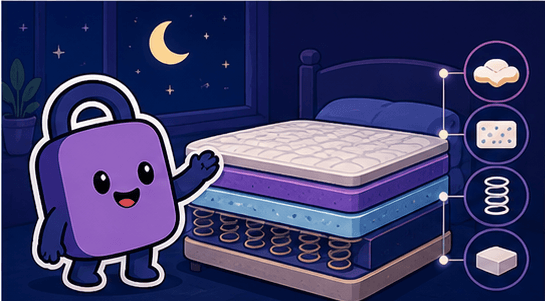
Mattress Guide: The Science Behind Your Bed
Have you heard that choosing a bed is a science? In reality, your mattress significantly impacts sleep quality. Let's explore scientifically why the right mattress matters and which type suits you best.

Dust Mites in Your Bedding? Allergy Symptoms and Proper Washing Methods
Did you know that dust mites hiding in your bedding could be affecting your sleep quality? These invisible creatures can trigger allergic reactions, causing nasal congestion, sneezing, and itching that disrupt your rest. Learn about dust mites and discover effective management strategies.

Body Pillow Guide: Benefits and How to Use One
A body pillow is a long pillow designed to support your entire body, particularly popular among side sleepers. From pregnant women to those with back pain, many people use body pillows. Learn about the correct usage and benefits of body pillows for better sleep.

Blackout Curtains for Better Sleep: Complete Guide to Choosing and Using
Light is one of the biggest disruptors of quality sleep. Even small amounts of light can interfere with melatonin production and disrupt your circadian rhythm. Blackout curtains offer a simple yet effective solution to create the dark environment your body needs for optimal rest. Here's everything you need to know about choosing and using blackout curtains for better sleep.

Mood Lighting and Sleep: How Light Color Affects Your Circadian Rhythm
The color temperature and intensity of light in your environment significantly impacts your sleep quality. While mood lighting can create ambiance, certain colors and brightness levels can either promote or prevent good sleep. Understanding the science of light and sleep helps you optimize your environment for rest.