How Sleep Debt Affects Work Performance: When Missing 1 Hour Daily Adds Up
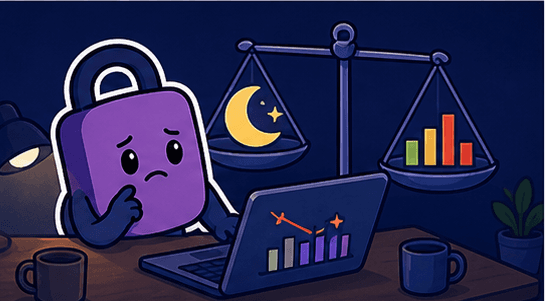
Think you can function fine on 6 hours of sleep with just a cup of coffee? When small amounts of lost sleep accumulate each day, your work capacity eventually becomes equivalent to someone who stayed up drinking all night. Let's explore how 'sleep debt' erodes your productivity and how to pay it back.
Calculate Your Sleep Debt
Calculate your accumulated sleep debt from the past week.
What is Sleep Debt?
Sleep debt is the cumulative difference between the sleep you need and the sleep you actually get. For example, if you need 7-8 hours but only sleep 6, you accumulate 1-2 hours of debt daily. That's 7-14 hours per week, over 30 hours per month.
The problem is this debt doesn't just manifest as 'feeling tired.' Sleep debt quietly but surely degrades cognitive ability, emotional regulation, and decision-making—all core functions for work performance.
Sleep Debt Accumulation Stages
Initial Stage
Slight decrease in focus, feel like coffee can get you through
Caution Stage
Slower reaction time, reduced creativity, increased irritability
Danger Stage
Impaired judgment, more mistakes, microsleep episodes
Severe Stage
Cognitive impairment similar to being intoxicated
The Shocking Truth About 6 Hours of Sleep
Think '6 hours is enough'? Scientific research says otherwise.
University of Pennsylvania Study
After 2 weeks of sleeping only 6 hours, subjects showed the same level of cognitive decline as those who had been awake for 24 hours straight.
What's even more shocking is that they still felt 'fine.'
Blood Alcohol Comparison Study
Being awake for 17-19 hours produces cognitive impairment equivalent to a blood alcohol level of 0.05%—well above the legal driving limit in many countries.
Working in a state of chronic sleep deprivation is essentially working 'intoxicated.'
Harvard Medical School Research
Productivity losses from sleep deprivation cost the US economy alone $411 billion annually.
It impacts not just individual careers but entire organizations.
5 Ways Sleep Debt Destroys Work Performance
Decreased Focus and Attention
Sleep deprivation impairs prefrontal cortex function—the brain region responsible for concentration, attention, and working memory.
💡 Zoning out during meetings, having to re-read emails multiple times, making simple calculation errors.
Poor Decision Making
A tired brain cannot accurately assess risk and reward. This leads to impulsive decisions or endless procrastination.
💡 Choosing short-term gains over long-term benefits in important business decisions.
Reduced Creativity
REM sleep is essential for creative problem-solving and insight. Sleep debt sacrifices REM sleep first.
💡 Unable to come up with new ideas, just repeating old approaches.
Emotional Dysregulation
Sleep deprivation increases amygdala activity (emotional center) by 60% while weakening prefrontal connections (emotional control).
💡 Overreacting to minor feedback, increased conflicts with colleagues.
Memory Impairment
During sleep, the brain converts daily learning into long-term memory. Without adequate sleep, this process fails.
💡 Can't remember yesterday's meeting details, frequently forgetting newly learned procedures.
Microsleep: The Invisible Danger
When sleep debt accumulates, 'microsleep' occurs—1-30 second periods of unconscious sleep that you don't even notice.
Microsleep During Meetings
You might miss crucial information or lose your train of thought during presentations
Microsleep While Driving
A 3-second microsleep at 100 km/h means driving 83 meters with your eyes closed
Microsleep During Critical Tasks
Leads to data entry errors, code bugs, and document mistakes
The scariest thing about microsleep is that you don't know it happened. You might think 'I just zoned out for a second,' but you actually fell asleep for several seconds.
How to Pay Off Sleep Debt
The good news is sleep debt can be repaid. However, sleeping in all at once isn't the solution.
Pay Back Gradually
Increase your sleep time by 30 minutes to 1 hour each day. Sleeping an extra 2-3 hours on weekends helps too.
- •Go to bed 30 minutes earlier than usual
- •Sleep 1-2 hours later on weekends (not too much to avoid circadian disruption)
- •Use strategic power naps (20-30 minutes)
Improve Sleep Efficiency
Even with the same sleep duration, increasing the proportion of deep sleep enhances recovery.
- •Reduce screen time 2 hours before bed
- •Keep bedroom temperature at 65-68°F (18-20°C)
- •No caffeine after 2 PM
- •Maintain a consistent sleep schedule
Strategic Napping
A 20-30 minute nap between 1-3 PM can significantly boost afternoon productivity.
- •Try the 'coffee nap' (drink coffee then immediately take a 20-minute nap)
- •Don't exceed 30 minutes (to avoid sleep inertia)
- •Avoid napping after 4 PM
One-Week Sleep Debt Recovery Plan
If you've accumulated more than 10 hours of sleep debt, try this weekly plan.
Basic Recovery
Go to bed 1 hour earlier than usual. Wake up naturally without an alarm (best on weekends)
Rhythm Adjustment
Set consistent sleep and wake times. Wake up at the same time every day
Habit Reinforcement
Review sleep hygiene. Adjust caffeine, alcohol, and screen time
Evaluate and Maintain
Compare how you feel now versus a week ago. Note improvements
⚠️ Fully recovering from 10+ hours of debt may take 2-3 weeks. Don't rush it.
Managing Sleep Debt at Work
Schedule Important Tasks in the Morning
Most people have peak cognitive function between 10 AM and noon. Schedule critical decisions and creative work during this time.
Use the Post-Lunch Slump
During the natural drowsy period around 2-3 PM, schedule routine tasks or meetings. Take a short walk or stretch if possible.
Optimize Meeting Length
Long meetings are ineffective when sleep-deprived. Include a 5-minute break for meetings over 45 minutes.
Use Bright Lighting
Natural light or bright artificial lighting helps maintain alertness. Getting some sunlight in the afternoon is also beneficial.
Frequently Asked Questions
Can I pay off sleep debt by sleeping in on weekends?
It helps partially. However, sleeping too late creates 'social jet lag' making Monday mornings even harder. Stick to just 1-2 hours extra.
Can coffee offset sleep debt?
Caffeine only masks drowsiness temporarily—it doesn't restore cognitive function. Plus, it reduces sleep quality, potentially adding to your debt.
I think I'm a 'short sleeper' who only needs 6 hours
True short sleepers make up less than 1% of the population and it's genetic. Most people have just adapted to sleep debt and think they're 'fine.' Try sleeping adequately for 2 weeks and compare how you feel.
Does sleep debt affect long-term health?
Yes. Chronic sleep debt is linked to increased risk of obesity, diabetes, cardiovascular disease, depression, and dementia. Reduced work performance is just the tip of the iceberg.
How can I live debt-free?
Most adults need 7-9 hours of sleep. Determine your optimal sleep duration and prioritize getting it. Sleep isn't wasted time—it's a productivity investment.
Key Takeaways
- Sleep debt accumulates—even 1-2 hours short daily becomes serious within a week
- 2 weeks of 6-hour sleep produces the same cognitive decline as being awake for 24 hours straight
- A sleep-deprived brain functions similarly to an intoxicated one
- Focus, decision-making, creativity, emotional control, and memory all decline
- Microsleep occurs unconsciously, causing mistakes and accidents
- Debt can be repaid gradually, but full recovery takes time
- Adequate sleep isn't laziness—it's the best productivity strategy
Conclusion: Sleep is an Investment, Not a Cost
Busy modern workers try to gain work hours by cutting sleep. But research is clear: reducing sleep increases hours but dramatically decreases their quality.
If you cut 1 hour of sleep to work 1 more hour, you end up losing 2 hours worth of work capacity. Getting enough sleep isn't lazy—it's a strategic choice for peak performance.
⚠️ Important Notice
This article is for informational purposes only and is not a substitute for professional medical advice, diagnosis, or treatment. If you suspect you have a sleep disorder or any health condition, please consult a doctor or sleep specialist.

Take the First Step to Better Sleep
Build healthy sleep habits with Good Night Lock.
Download Good Night Lock